Tour guide Anouk Colombani is interested in popular memory. Her guided walks in Paris and Seine-Saint-Denis recount both the history of the places visited and that of the people who lived there. Between collective memory and individual destinies, Anouk takes you in the footsteps of the ordinary people who crossed paths with history, from the Paris Commune to World War II,
including workers, resistance fighters, and Communards.
A philosopher originally from Seine-Saint-Denis, Anouk Colombani is a multifaceted tour guide.
While working on extreme violence, she had the idea of becoming a tour guide at the Shoah Memorial. Today, she creates neighborhood tours on state violence, crisscrossing the Paris region to recount the Shoah, World War II, the Algerian War, and more "everyday" repression (such as during the Paris Commune or May 1968). These tours are a way of understanding both the mechanisms of repression and the processes of resistance. As a response to this work, she helps people discover Seine-Saint-Denis and Paris through what cannot be seen: small acts of resistance and the layers of transformation brought about by the inhabitants and users of cities. Through her research into major and minor events, she transforms the places, stories, and buildings she encounters into heritage sites.
Anouk Colombani leads tours on the Paris Commune of 1871, Jewish life in the 1930s, World War II, the Algerian War, May 1968, and the development of Greater Paris through its road networks and city centers.
Hello Anouk, you are originally from Pierrefitte-sur-Seine and you are interested in popular culture. Can you tell us about your background and what fascinates you about the transformation of places in the northern suburbs of Paris?
I started out as a guide at the Shoah Memorial, particularly in Drancy, thanks to my training in history and – above all – my research in philosophy on the themes of extreme violence and practices of reconciliation. I have worked extensively on the issues of national reconciliation and the tension between the scientific and popular uses of history.
My shift towards more socio-urban walks is due to having grown up in an environment where people talked a lot about history, the transformation of streets, struggles... Perhaps because I come from a family that doesn't have a family home. As I grew up, I realized that the 93 was constantly changing and that, depending on your age and background, you didn't see the same things. My grandmother, who lived in Les Courtillières de Pantin, regularly forgot that the metro no longer stopped at Porte de la Villette but at La Courneuve. I know someone who regularly gets upset about the fact that Paris 8 University is located on the site of the former municipal stadium in Pierrefitte. I grew up among wastelands and allotments; almost everything is built up now, but there are farms in Fortes Terres (in Pierrefitte), in Parc de la Courneuve, in Romainville... I think it's important to preserve these layers of geographical and social memory by linking them to individual and collective histories. History is not only about places, it's also about the people and communities who lived there.
You have several tours focused on women and feminism. Why did you choose these themes?
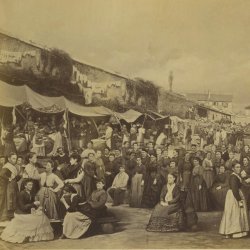 I first organized tours on the Communardes, then on the Résistantes, and finally on lesbian cabarets, with the Rue de la Commune collective, because we feel that history continues to be very male-dominated. In society, we like to talk about female pioneers and female figures who are considered important, but we still don't talk about women in the plural. We decided to do our bit by creating walks about women in collectives, women's groups, and feminist groups. This angle is present in all our tours. For us, it's about telling history from the perspective of women, not just sprinkling women into history.
Furthermore, the urban walking tour is interesting because it also challenges the idea that women belong indoors. When you add to this the fact that the audience is overwhelmingly female, it creates something very funny: self-constituted single-sex groups reclaiming public space to take back control of history!
Have any women inspired you in your career?
There have always been women in my daily life. Teachers, of course, activists who spent their weekends organizing or preparing things while looking after their children, but also colleagues. And, of course, public figures and artists, writers like Elsa Triolet.
I have also always admired great female athletes, without any desire to imitate them. I really liked Surya Bonaly in figure skating, and I will never forget when she refused to go up on the podium to denounce racism in that environment. But what struck me was the determination of these athletes and their ability to work their bodies to such an extent.
There are also all the women I work on. For example, I often think of Nathalie Lemel, a Communard who left her violent partner in the 1860s and became a bookbinder while raising her children. At the end of the Commune, she was sentenced to deportation to a fortified enclosure. When she returned nine years later, she couldn't find work because she refused to betray her beliefs.
My work is also about paying tribute to all these women who fought to live their lives as they saw fit.
Do you think women are sufficiently represented in your profession? Are there any challenges associated with your profession as a woman?
Tour guide is a very feminized profession with all that that implies: under-recognition and under-remuneration. The profession has become more masculinized in recent years in line with the development of more diverse and valued career paths.
Today, I see a distinction between those who continue to claim the title and practice of tour guide and the rise of the notion of "mediator", which corresponds to another profession that aims to mediate between an object and an audience. I believe there is a real challenge in defending the profession of tour guide/interpreter. Interpreting works of art, an urban space, or a story is a profession in itself and deserves recognition.
Your first collaboration with ExploreParis.com was centered around the celebration of the 150th anniversary of the Paris Commune. You are also a member of the board of the association Faisons vivre la Commune (Let's Keep the Commune Alive) and created the website ruedelacommune.com. Tell us about your interest in this subject and the virtual tours you have developed on it. What are your hopes for the future of your collaboration with ExploreParis.com?
The Commune is an irreconcilable part of French history (with international significance as well). Once I had completed my doctorate in philosophy, I began working on this history, which I knew about, but not in great detail. I teamed up with a songwriter and an illustrator, and we came up with a musical tale. But what we wanted above all was to unearth popular places linked to the Commune. The northern suburbs of Paris, with their communist influence, contain a large number of them. I did a lot of research on the streets and buildings of the Communards in Saint-Denis, Pierrefitte, Aubervilliers, La Courneuve, but also Montreuil and Bagnolet... and I realized that Pierrefitte stood out in the landscape due to the large number of streets named after Communards, not to mention a nursery and two schools. These streets and establishments have a history, which is itself linked to municipal communism. So there was something to be done.
I also organized tours of the 10th arrondissement in Paris by chance while working with the Françoise Sagan media library, located in what remains of the former Saint-Lazare prison.
Thank you very much, Anouk!
Find Anouk Colombani's contributions on ruedelacommune.com.
To learn more, discover all our guides and lecturers in our portrait gallery.