 Find the best spots in Paris and Seine-Saint-Denis to observe the sky and its phenomena: eclipses, meteor showers, the Geminids, sunrises and sunsets, supermoons... Don't miss these beautiful natural phenomena. Look up!
Eclipses, Stars, and the Moon to Watch in Paris
Lunar or solar eclipses, total or partial, a red moon, a supermoon, shooting stars... here are a few dates to keep in mind for observing them from France. Lunar eclipses—whether partial or total—occur between two and five times a year, unlike solar eclipses. Shooting stars occur every year.
On the night of August 15–16, 2026, the crescent Moon and Venus will come close together. A spectacle visible to the naked eye—surprising and not to be missed.
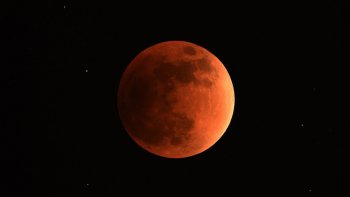
The “copper moon” will be visible at dawn with a 96% coverage. This is an exceptionally deep partial lunar eclipse (no protective glasses needed).
The lunar eclipse begins at 4:30 a.m. and reaches its maximum at 6:12 a.m.
The eclipsed portion will not simply turn black, but will glow slightly with a coppery-red hue.
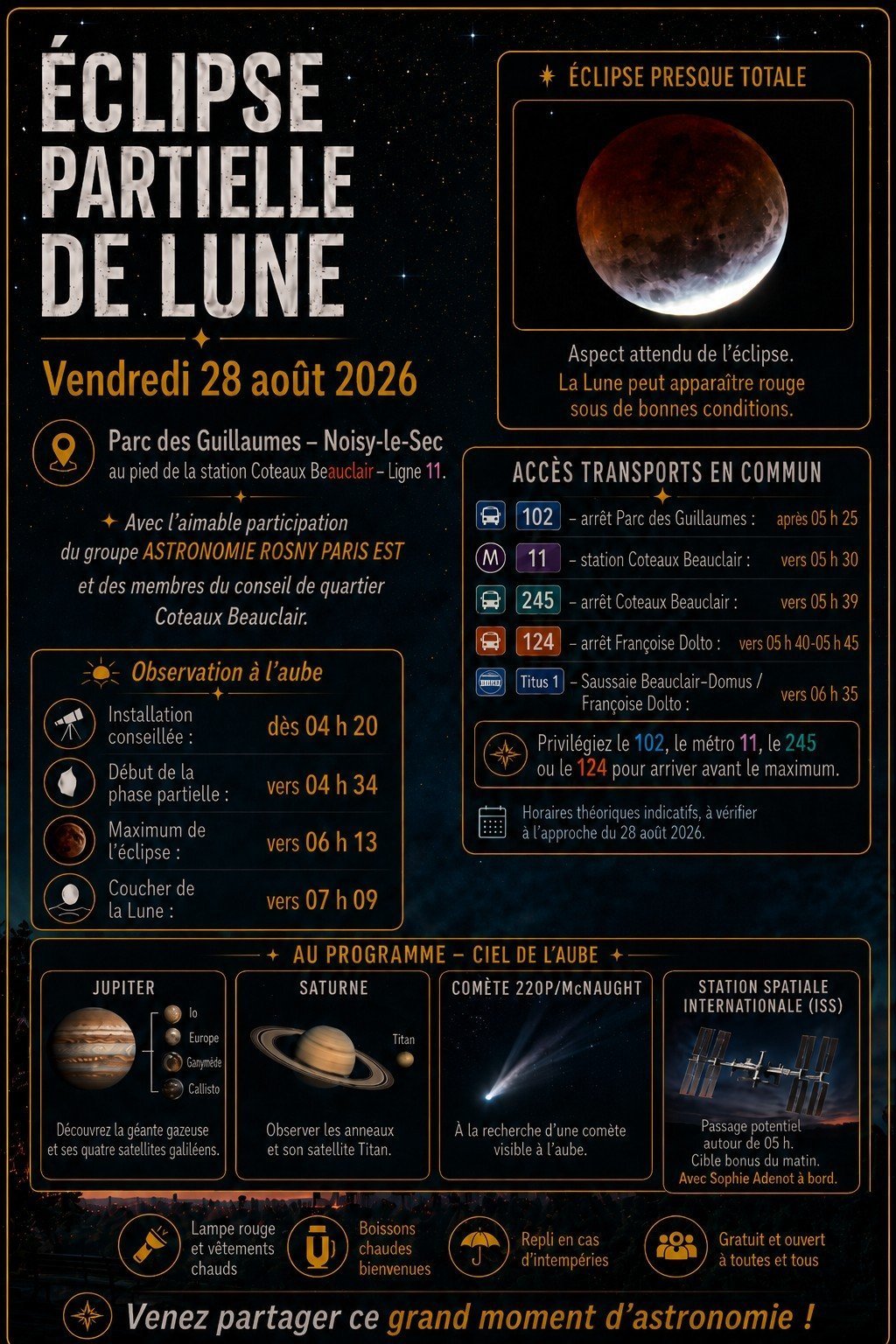 Friday, August 28, 2026: Events centered around the lunar eclipse at Parc des Guillaumes in Noisy-le-Sec
Join us in the early morning to witness this exceptionally deep partial lunar eclipse.
The penumbral phase will begin around 3:24 a.m., the partial phase around 4:34 a.m., and the maximum will occur around 6:13 a.m., when approximately 93% of the Moon’s diameter will be immersed in the Earth’s shadow—giving the appearance of a nearly total eclipse. Depending on atmospheric conditions, the eclipsed portion may take on a reddish-orange or coppery hue.
Several amateur astronomers will be in the park starting at 4:15 a.m. to welcome you and guide you in observing the sky.
Depending on the weather, members of the ASTRONOMIE ROSNY PARIS EST group will offer, in addition to the eclipse, observations of Jupiter and its Galilean moons, Saturn and Titan, possibly Comet 220P/McNaught, and, if possible, the potential passage of the ISS around 5:00 a.m. (to be confirmed).
The park is accessible by car as well as by public transportation for the first departures (bus and metro—see the poster for approximate schedules and RATP lines).
Location: Parc des Guillaumes, Rue du Trou Morin, 93130 Noisy-le-Sec
In 2026, the Geminids will peak on the night of December 13–14, 2026. Try to catch a glimpse of the Geminids, a “shower of stars and stardust…”
Get away from light pollution and find a spot that’s a little higher up (see below for some suggested locations). The Geminids are visible every year in December.
Saturday, June 19, 2027, at 2:45 a.m. — The Strawberry Moon, also known as the “Rose Moon” or “Honeymoon,” will light up the sky over Paris. This supermoon is a full moon that occurs every year, as it marks the first full moon of summer in the Northern Hemisphere. The moon will not turn red or pink, as this name is primarily linked to the harvest calendar and not to its appearance.
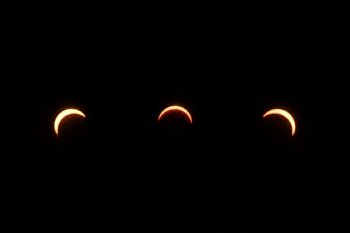 The next partial solar eclipse will take place on Monday, August 2, 2027, lasting a few minutes, and will be partially visible in France. More than 60% of the Sun will be obscured in certain regions (72% in Toulouse and total in southern Spain near Cádiz) with the sun higher in the sky.
Wear special eclipse glasses and, above all, do not look through a phone or camera without a filter. Your retina is at risk of severe and permanent damage.
The next total eclipse will take place on September 3, 2081, in France!
> On the night of August 12–13, 2027, the Perseids take center stage. It’s the most famous meteor shower of the year!
Tip: Look toward the northeast and find the constellation Perseus at the bottom of the “W” formed by the constellation Cassiopeia. The “meteors”—which we also call shooting stars—appear to come from the constellation Perseus.
Find the best view points of Paris and Seine-Saint-Denis to watch the sky and all that happens in it: eclipse, rain of stars, sunrise and sunset...
The highest point in Seine-Saint-Denis is located in Les Lilas. It is the Romainville Plateau, which rises to 131 m, just a stone's throw from the TDF television tower. This plateau is an extension of the Belleville-Ménilmontant hill in Paris. Next comes the Vaujours Plateau (130 m) and then the Avron Plateau (115 m).
The Buttes-Chaumont Park also offers a beautiful view of the Paris skyline.
The parks of Seine-Saint-Denis allow you to enjoy the sky with less intense lighting.
Why not reserve a table at a restaurant with a view in Seine-Saint-Denis to watch the lunar eclipse? Discover hotels with a view in Paris.
Don't miss the Night of Stars in August and the Sky and Space Meetings in Paris
