After exploring the world, Tristan Bayle settled in Seine-Saint-Denis. He learned about the history of this area and followed its developments. Today, he recounts his experiences in his own words to audiences from all over the world, leading walks in Paris and Seine-Saint-Denis while continuing to guide tourists in several regions of France. Discover his portrait.
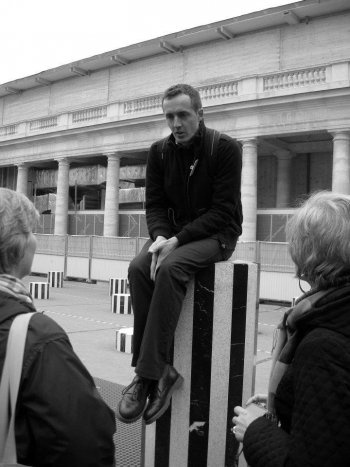 Hello Tristan, can you tell us about your background?
 After growing up in Normandy, I studied literature followed by history and geography in Paris. During my master's degree, the army approved my application to volunteer for technical assistance in New Caledonia.
So I spent a year and a half in Nouméa. In 1998, on my way back, I took a long trip to the Middle East, hitchhiking with a friend. We hitchhiked from the Sultanate of Oman to Paris, passing through the United Arab Emirates, Saudi Arabia, Jordan, Syria, Turkey, Greece, and Italy. It's a trip that would be almost impossible to do today under the same conditions.
When I returned, I didn't have a penny to my name. A friend who guided groups of American tourists suggested I do the same.
So I started guiding groups of American tourists throughout Europe, which I still do occasionally, even though I work much more as a local guide.
In fact, seven years ago, I obtained my "tour guide" license and began guiding American tourists, mainly at the Louvre, Versailles, etc.
During COVID, our guide federation, the FNGIC, organized tours of Parisian neighborhoods in partnership with the Paris City Hall. The federation wanted to offer two tours outside Paris, including one in Saint-Denis. Since I lived in Pantin, in Seine-Saint-Denis, I was asked to organize a tour of the historic center of Saint-Denis. However, I am no closer to this city than the residents of the 18th arrondissement! So I went to the Plaine Commune tourist office to prepare for this tour. There I met Dominique Gandolfi, an excellent tour guide who worked for the office and who gave me advice on the different places to visit.
I then organized other tours with her, including a tour of the athletes' village under construction. These were the very first tours for French tourists to this site in 2020. It was the very beginning!
One thing led to another, and I developed a real affection for this area, which I already knew but where I didn't usually guide my usual American tourist clients!
That's how I started offering tours on urban themes in several towns in Seine-Saint-Denis. For me, it's a much more interesting challenge than guiding in Versailles, for example.
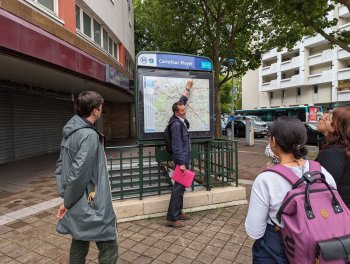 Firstly, because it is poorly understood. The history of Paris's development means that the capital has become densely populated in a very small area. I am referring to the small Paris and its 20 arrondissements, which, excluding the woods, cover only 85 km², which is very small compared to other major European cities.
In contrast, Seine-Saint-Denis is 2.5 times the size of these 20 arrondissements. Visitors rarely have this in mind. The caricatures made about this department, which is much larger than the capital, lead to misunderstandings. My job is to refocus attention on the facts to avoid these caricatures. Just as the Marais is not like Belleville, or Montmartre is not the Latin Quarter, there are significant differences between certain neighborhoods and towns in the 93. These differences – despite real social difficulties in some areas – are also a source of richness.
The urban dynamics in Seine-Saint-Denis stem from a relatively recent past: the 19th century and the industrial revolution. Then, 50 years ago, deindustrialization and the oil crisis played a major role.
It's a fairly recent history, which visitors can easily relate to. If you talk to them about their great-grandparents, factories, or the transition from the countryside to the city, these are things that often touch them a little more than the history of the Parisii 2,200 years ago.
As for the bad reputation of Seine-Saint-Denis, it is based on news stories which, even if they are recurrent, do not represent the whole of the department. In most of the area, the inhabitants live peacefully and are attached to their living environment. On my walks, my clients often come from the inner city and sometimes have preconceptions due to the media's magnifying effect on these news stories. Talking about this openly is part of my job as a guide.
The fantasy image of the suburbs as a concrete wasteland has even prevented visitors from imagining a bucolic 93. And yet! When I guided groups between Le Bourget, Dugny, and Georges Valbon Park on the theme of the Olympic Games, visitors were very surprised to see the north of the park in particular and to find themselves in the countryside, even though we were only a few kilometers from little Paris. The park covers more than 400 hectares, compared to less than 25 for the Luxembourg Gardens. Cruises on the Seine around Île Saint-Denis are also very rural. One of the three parts of the athletes' village is located on Île Saint-Denis, which is even more accessible via the brand new Saint Denis Pleyel station on line 14 and the new Louafi Boughera bridge bridge (a legacy of the Olympic Games). When you go to the north of the island, with its departmental park, you are on the banks of the Seine and you feel as if you are back in the days of Manet, Caillebotte, or Sisley, who gave his name to the local middle school.
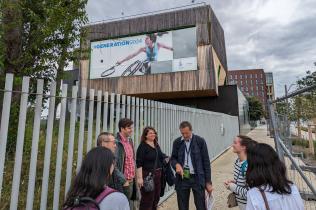 Lack of knowledge about the department led to the same misunderstandings and exaggerations about the organization of the Olympic Games in Seine-Saint-Denis.
Between the Games being awarded in 2017 and 2024, newspapers and social media sought to create buzz at the expense of the Olympics without seeing the long-term benefits that the Games could bring to a department in need of investment. I imagine that bashing the organization was going to get more views than talking about the positive aspects: apparently, no one is interested in trains that run on time...
A lot of false information was written about the financing, transportation, construction of the village, etc. For four years, we were a small group of guides fighting against preconceived notions and highlighting the environmental standards that applied to Olympic construction projects. Contrary to what has been repeated everywhere, it was not only the Porte de la Chapelle Arena and the Saint Denis Aquatic Center that were built for the Games, but also a whole series of sports training facilities for athletes (swimming pools, stadiums, gymnasiums, etc.).
It should not be forgotten that 80% of the public money spent on the Olympic Games was spent in our department. This has enabled a slight rebalancing in terms of sports facilities, as the 93 is very lacking in this area, but also the redevelopment of public spaces, which is beneficial on a daily basis (I am thinking, for example, of the area around the Saint Denis canal).
Our work as guides in Seine-Saint-Denis therefore also involves putting certain fantasies into perspective, such as the supposed gentrification of the 93 due to the Olympic Games. According to some journalists, Seine-Saint-Denis was suddenly going to become as gentrified as the Marais. By showing visitors the complexity of the area, they can see that the Olympics have had an impact on very limited areas, often on former wastelands. Some long-term changes are not particularly due to the Olympics, but more to the arrival of the Grand Paris Express. Personally, I don't think it's a bad thing to revitalize areas that need it, including by bringing in higher-income populations on an ad hoc basis. Isn't that also what social diversity is all about? As I see my tours as open conversations, this has led to contradictory, sometimes heated debate...
Offering guided bike tours is a choice based on the geography of the 93 department. We are in a large area where the notable and heritage sites are sometimes quite far apart. A highly specialized tour of a single site is not always what our customers are looking for. Bicycles offer the possibility of covering greater distances, which is appealing.
Once again, it depends on the theme: the historic centers of Pantin or Saint-Denis require nothing more than a good pair of sneakers.
First and foremost, it's the people who work there; I've found them to be a very friendly team that I enjoy working with and developing new projects.
Secondly, I like the idea that Explore Paris covers the whole of Paris, not just the small part we were talking about earlier. We're attracting a new clientele who are crossing over the "boundary". We're in an area where things are happening, where there's life and people.
Finally, I think the concept is brilliant: Explore Paris manages to offer a wide variety of experiences for everyone, young and old Parisians alike. The Explore Paris platform has made it possible to create niche tours that would have been impossible to organize otherwise. A private agency does not have the means to launch such specific tours.
Thanks to the departments involved in the project, Explore Paris has the budget and the desire to promote and showcase this offering, which is simply unique.
No, I actually like to vary the tours. Having a favorite tour means you're happy to do the same thing all the time, which isn't the case for me.
That said, I really enjoyed organizing tours around the legacy of the Olympic Games.
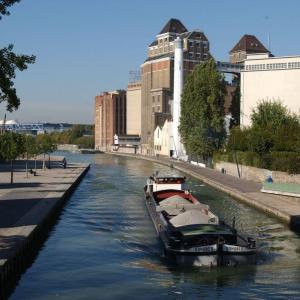
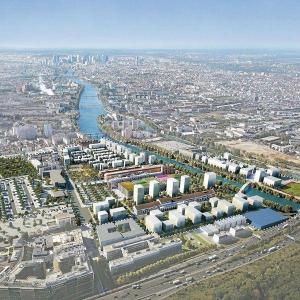
There was a bike tour that started at La Villette and went to Île Saint-Denis. We passed by the various footbridges that were built for the Olympics, the renovated Saint-Denis Canal, the Stade de France, the Olympic Aquatic Center, the Pleyel urban crossing, and the athletes' village, among other sites. This route really allowed us to discover the area around the Saint-Denis canal, which is a key feature of this part of the department.
I also enjoyed working in Le Bourget and Dugny, which are relatively unknown towns.
Beyond these tours, it is meeting visitors that makes our job so special. Many foreign delegations came during the Olympic Games, particularly to the athletes' village. Working in English allows me to show a little-known area to people who have no preconceived notions about the place. They are a very open-minded clientele to whom we can explain that, while we are in an area that is not very wealthy, it is very dynamic, young, and constantly changing. They are receptive to that.
I have a good place in Saint-Denis: Transmontano, a small Portuguese restaurant on Rue Daniel Casanova. It's located in the heart of Bel Air, a little-known neighborhood of small workers' houses from the early 20th century. It's a restaurant where you can get a starter, main course, dessert, glass of wine, and coffee for €15. And it's all homemade! What could be better?
It's not really a neighborhood that tourists visit, even though it's just across from the Stade de France, connected by the magnificent new Lucie Bréard footbridge over the canal. This area has a lot of potential, and families can still find affordable houses with gardens here before the extension of the T8 tramway and line 15 of the Grand Paris Express arrive. It's a neighborhood that has been wrongly overlooked!
Otherwise, I like to stroll around little Pantin, very close to my home. Here too, there are mainly small houses because it is a quarry area where it was not possible to build tall buildings or large factories.
This is another very pleasant neighborhood.